What Elite Riders Do With Their Eyes That Beginners Don’t
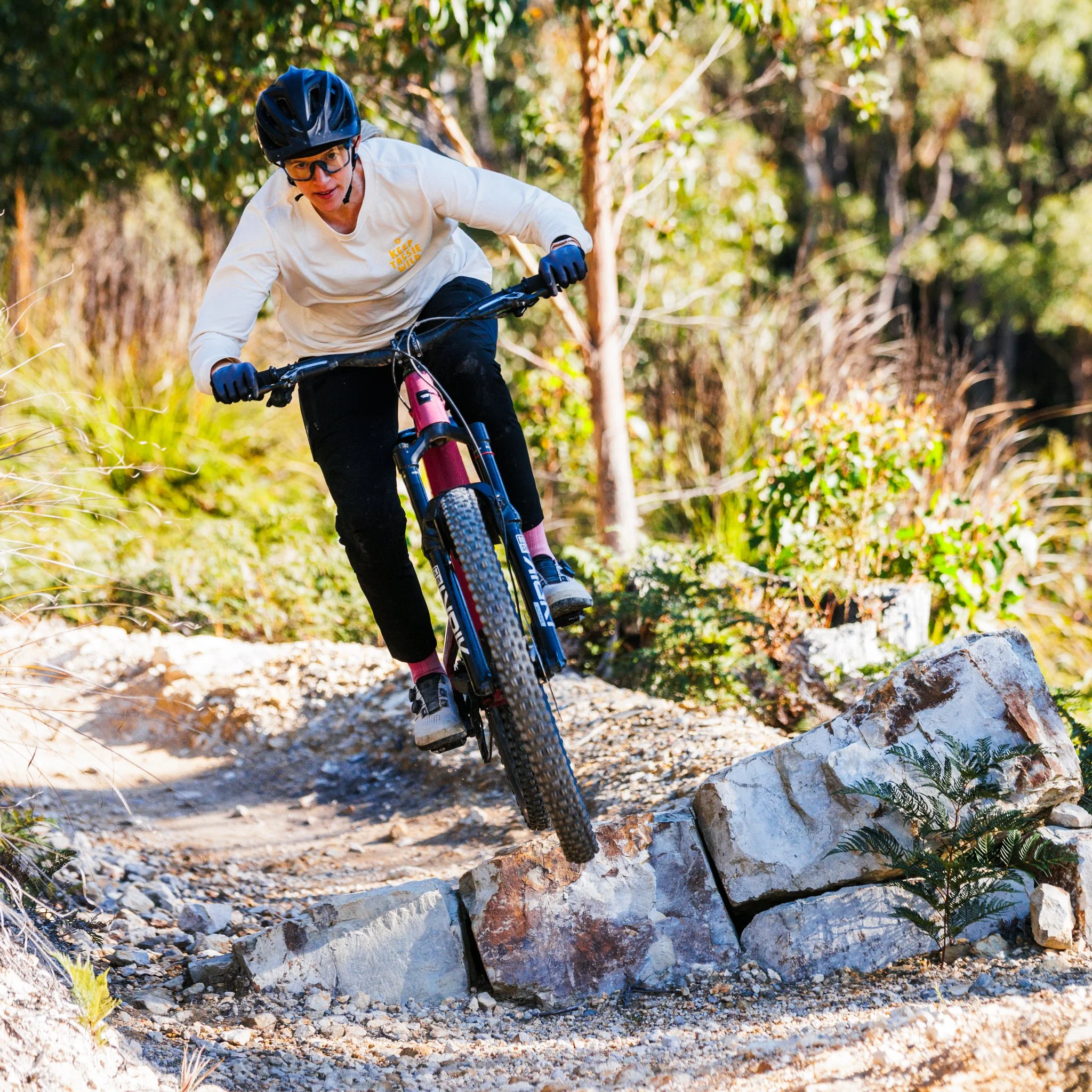
Watch a beginner ride a technical trail and watch an expert do the same thing. The difference is not strength. It is not bravery. It is not even bike handling in the way most people think about it.
The difference shows up first in the eyes.
Decades of performance research across sport tells us the same story. Experts see differently. They look earlier, they look longer, and they look with far less visual noise. Their eyes settle on relevant information and stay there long enough for the body to organize around it. Beginners, by contrast, tend to scan frantically. Their gaze jumps, their attention fragments, and their movements follow suit.
This visual difference is not stylistic. It is measurable, it has a name. And it helps explain why certain riders appear calm, precise, and confident even in chaotic terrain.
That concept is called “Quiet Eye”.
What Is “Quiet Eye”?
Quiet Eye is a term coined to describe a very specific visual behavior seen in high-level performers.
Technically, it is defined as a stable fixation or tracking gaze within a small visual angle for at least 100 milliseconds. That time window matters - it is the minimum duration the brain needs to set key movement variables like force, direction, timing, and coordination.
In early research, Quiet Eye was studied in sports like golf putting, basketball free throws, and shooting. These are controlled, self-paced tasks. Non-professional athletes can train to achieve QE levels similar to professionals. For example, a university basketball team trained in QE improved their free-throw accuracy by 22% over two seasons, surpassing the average professional accuracy.
In practical terms, Quiet Eye reflects how well an athlete:
Selects the most relevant visual information
Filters out distractions
Commits attention early enough to allow the movement system to organize efficiently
Fixation, Tracking, and How Riders Actually Use Their Eyes
Mountain biking uses two main types of gaze behavior.
The first is fixation. This happens when a rider looks at a stable reference point, like the exit of a corner or the runout of a rock roll. Fixation allows the body to organize around a known spatial target.
The second is tracking gaze. This happens when the rider or the environment is moving relative to each other. In riding, this often looks like visual pivots. The rider anchors their gaze on a future point while peripheral vision manages what is happening underneath them.
Expert riders blend these two seamlessly. Their eyes are not frozen, but they are not chaotic either. There is rhythm to when they scan and when they settle.
Beginners tend to do the opposite. Their gaze jumps constantly. They look down at the front wheel, then up, then at the obstacle, then back at the bike. Each jump interrupts the flow of information going to the brain.
Why Quiet Eye Works
To understand why this matters, it helps to know one simple thing about how the brain processes vision.
There are two main visual systems at work.
One system helps you identify things. It answers questions like “What is that?” or “Is that a root or a rock?” This system is slower and more conscious.
The other system helps you interact with the world. It answers questions like “Where is that relative to me?” and “How do I move through it?” This system is fast, automatic, and deeply tied to movement.
When riders fixate too briefly or move their eyes too often, the movement-focused system does not get clean information. The result is delayed reactions, stiff movement, and hesitation.
Quiet Eye gives the brain a clean snapshot of the environment. That snapshot allows movement to happen automatically, without constant conscious correction.
In short, longer and more stable gaze leads to smoother and more confident movement.
Quiet Eye, Anxiety, and Why Riders Get Stuck
Quiet Eye also explains something coaches see all the time.
Target fixation.
Under stress, the brain shifts attention toward threats. Trees, edges, rocks, consequences. This is driven by the part of the brain responsible for survival. The eyes lock onto the problem, not the solution.
The issue is that the bike follows the eyes.
When a rider stares at what they want to avoid, they are feeding their movement system the wrong information. The result is tension, braking at the wrong time, or freezing altogether.
Training Quiet Eye is not just about vision. It is about teaching the brain to stay goal-directed under pressure. Riders who can re-anchor their gaze onto positive space often experience an immediate drop in tension. Their riding looks calmer because it is calmer.
This is one of the fastest ways coaches see confidence spikes on the trail.
What This Looks Like on the Trail
Rather than thinking about Quiet Eye as a drill or a technique, it helps to see how it shows up in real riding.
In corners, experienced riders are already looking toward the exit before they begin to steer. Their eyes lead the turn by a noticeable margin. This creates a feed-forward loop where the body sets lean angle and pressure before the bike arrives.
In technical terrain, experts gather visual information early, then allow peripheral vision to manage what is happening close to the bike. They trust the snapshot they took earlier rather than micromanaging every movement.
In flow trails, their gaze has rhythm. Scan, settle, move. Not staring, not flicking, but alternating between information gathering and commitment.
This is why cues like “look through the turn” work when they work. They are not magic words. They are reminders to adopt the visual behavior of skilled riders.
Vision = Confidence
There is a feedback loop between vision and confidence.
Longer Quiet Eye leads to more successful movement. Successful movement builds confidence. Increased confidence makes it easier to maintain Quiet Eye.
This is why advanced riders often appear unshakeable. They are not ignoring risk. They are filtering it.
When coaches help riders adopt expert visual habits, they are not just improving technique. They are changing how riders perceive the trail itself.
Quiet Eye is not a trick. It is not a hack. It is a measurable, trainable skill that sits underneath almost every aspect of expert riding.
It can help to explain why experienced riders look relaxed in difficult terrain. It explains why beginners feel overwhelmed even on simple features. And it explains why vision-focused cues in riding can lead to breakthroughs in confidence.
When coaches teach riders how to see, everything else has a chance to fall into place.
Quiet Eye describes how attention and vision guide movement. In mountain biking, this shows up as terrain awareness - the ability to scan, prioritize, and act on the right visual information at the right time.
The GSMBC Reference Guide breaks this down in a mountain bike-specific context, showing how terrain awareness fits within a broader skills system that connects perception, riding skills, and coaching decisions into a practical framework.
Access to the GSMBC Reference Guide is included with GSMBC membership.
If you’re interested in learning more about the sources we used in this blog, check them out below.
Vickers (1996, 2007): Operational definitions of Quiet Eye.
Mann et al. (2007): Meta-analysis of expertise and gaze behaviors.
NeuroTracker (2023): Research on saccadic efficiency and situational awareness.
MTB Gaze Study: Fixation patterns on technical downhill terrain.
Piras & Vickers (2011): Concepts of gaze anchoring and visual pivots.
Williams et al. (2002): QE duration and movement programming.
Fixation Data: Expert vs. novice fixation durations on MTB trails.
Focal/Ambient Vision: Bikeradar analysis of visual processing streams.
Dorsal Stream: Activation of spatial awareness pathways.
Klostermann et al. (2018): Research on the Inhibition Hypothesis.
Wilson et al. (2009): Definition of stable fixation within 1° visual angle.
Bicycle Dynamics: Expert vs. novice control and decoupling strategies.
VOR Studies: Vestibular-Ocular Reflex and retinal image stabilization.
Land & McLeod (2000): Release point fixation in open-skill sports.
Saccadic Expression: Conserving cognitive resources via controlled saccades.
Tau Theory: Calculation of time-to-contact via rate of expansion.
Interceptive Timing: Gaze behavior during critical release moments.
GSMBC Tech Pillar: Framework for technical riding skills.
Coaching Mastery Curve: Four stages of skill acquisition and focus.
Vickers (2016): Neural networks and control of visual attention.
Mann, Williams, Ward, & Janelle (2007): Differentiating expert gaze behaviors.
Williams, Singer, & Frehlich (2002): QE in aiming responses.
Klostermann, Kredel, & Hossner (2018): Motor performance and QE duration.
Sun, Zhang, Vine, & Wilson (2016): Causal role of QE in intercepting targets.