finite vs. infinite games
inlcudes: 4 Tools and practices to try yourself.
In the classroom veteran schoolteacher flips through a decade-old lesson plan, scribbling fresh ideas in the margins. A MTB coach spins to the trailhead, silently replaying yesterday’s session to refine today’s approach.
Neither is “finished” – and that’s exactly the point.
Like the best teachers, great mountain bike coaches treat their career as an endless class, not a final exam. Every season, every student, every crash and learn moment is part of a journey that keeps unfolding. In the language of game theory, some professions are finite - with clear winners, deadlines, and trophies.
But coaching is an infinite game, one you play to keep playing, always chasing the next insight. The goal isn’t to “win” at coaching; it’s to continue growing and helping others grow, year after year.
Originally proposed by philosopher James P. Carse, this theory distinguishes between playing to win (finite games) and playing to continue the play (infinite games).
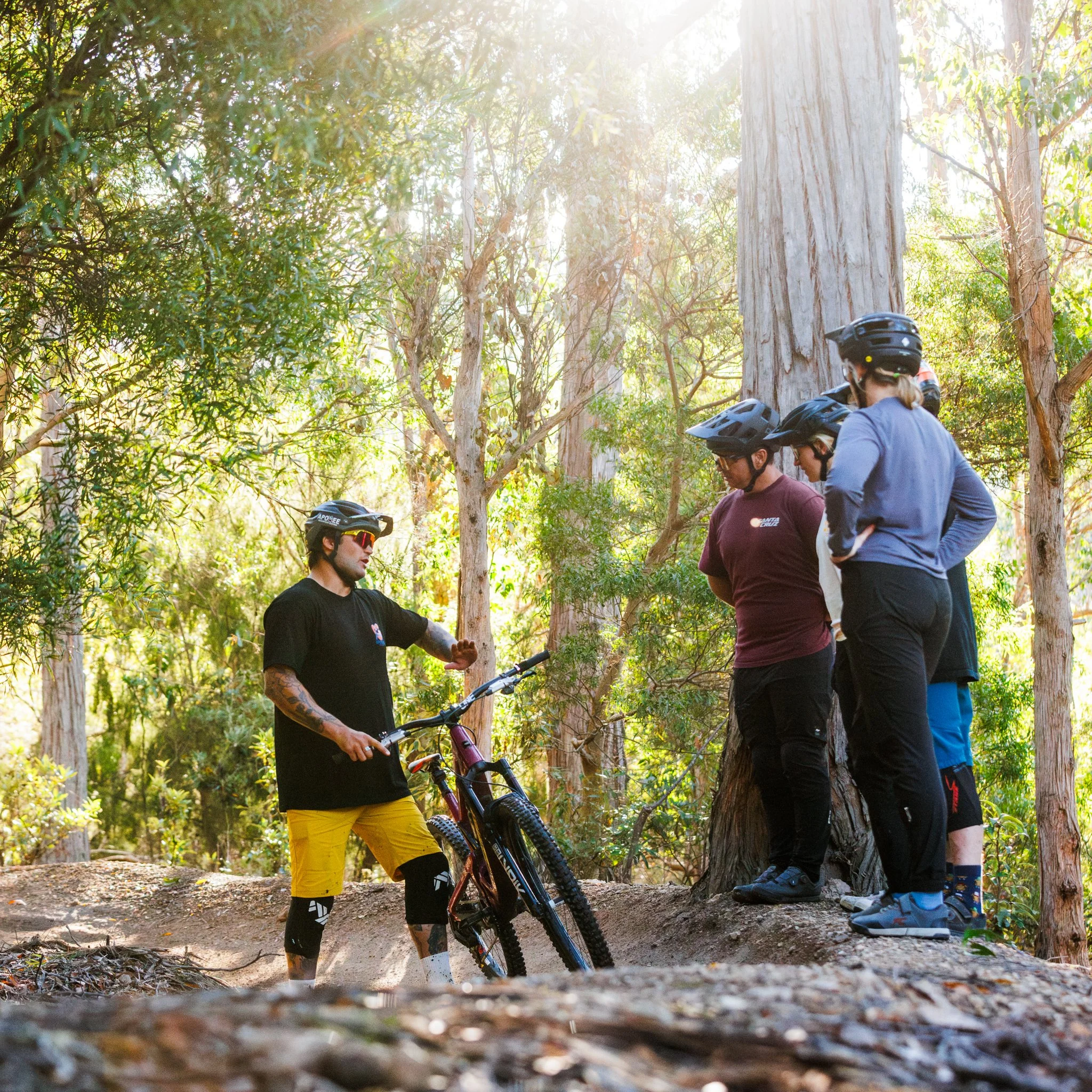
In the context of mountain bike (MTB) coaching and rider development, this mindset can make the difference between short-lived success and sustainable, long-term growth. MTB coaches, aspiring coaches, and riders can all benefit from understanding this concept as they strive to build skills, confidence, and a lifelong passion for the sport.
Finite vs. Infinite Mindsets
A new coach might fixate on reaching the next certification level or getting a resume-worthy result by year’s end – the finite approach. By contrast, coaches with an infinite mindset focus on the long game of mastery.
Rather than chasing credentials for their own sake, these coaches collect experiences and lessons. Achieving a Level 2 or Level 3 certificate isn’t a victory lap, but a checkpoint on a much longer trail.
“Level 4 isn’t the finish line. It’s the point where you realize expertise means continuing to grow, and helping others grow too.”
In other words, the higher you climb, the more you see there is to learn.
The Long Game in Practice
From PECAM to the Classroom: GSMBC formalizes this never-ending progression through frameworks like the PECAM skill development model and the Long-Term Coaching Plan. PECAM (Processing, Emerging, Consolidating, Autonomous, Mastery) charts how both riders and coaches advance over time.
In practice, a coach might start out Processing new teaching techniques, then see those skills Emerging as confidence grows. With repetition, they reach a Consolidating stage, things click more consistently. In the Autonomous stage, coaching skills flow naturally, even under pressure. Finally comes Mastery - not a permanent state of perfection, but a level where one can adapt, innovate, and even teach the skill to others.
Notice that Mastery isn’t an endpoint but a new beginning; it implies you’re now equipped to push into deeper challenges. Similarly, GSMBC’s Long-Term Coaching Plan (LTCP) encourages coaches to map out development over seasons and years, not just single sessions. It’s a blueprint for layering skills and objectives in a progressive way, so that each year builds on the last. This long view transforms coaching from a one-off clinic into a career-spanning mentorship. Just as a schoolteacher follows a curriculum across a semester (knowing real education unfolds in gradual arcs), an MTB coach with a long-term plan sees the big picture of a rider’s development.
Finite Goals: The Lure and the Limitations
Finite goals are not bad. They are a natural part of sport and development. Targets like finishing on the podium, landing a new feature, or passing a Level 2 certification can be highly motivating. They provide clarity, urgency, and structure, and they align with effective goal setting in coaching. As coaches, we use specific, measurable goals to spark progress and give riders a sense of success.
Problems arise when short-term performance becomes the sole focus. When winning or passing becomes the only measure of success, broader development is pushed aside. A rider focused only on winning the next race enters a fragile cycle. If they win, pressure shifts immediately to repeating it. If they lose, confidence can collapse. In both cases, progress narrows to the result, and learning, enjoyment, and curiosity fade into the background.
Research supports this. An overemphasis on outcomes can undermine intrinsic motivation and increase anxiety and burnout (Ryan & Deci, 2000). Coaching science consistently highlights the tension between short-term performance and long-term athlete development (Lloyd et al., 2015). Finite goals offer quick validation, but when pursued in isolation, they discourage risk-taking, limit learning from failure, and reduce long-term engagement.
The same pattern shows up in coach education. When coaches fixate on passing a course rather than developing the skills behind it, progress may appear fast but often lacks depth. An infinite approach treats certification as a checkpoint, not a finish line. Coaches balance assessment preparation with reflection, broad skill development, and real-world application. The outcome is not just a pass, but a more adaptable, confident coach who continues improving long after the course ends.
The Infinite Mindset: Learning adapting and growing
This shift is not about dismissing wins or certifications. They matter. Wins create direction and urgency. Certifications provide structure, shared language, and clear standards. Their real value, though, is not in completion, but in what they unlock next.
With an infinite mindset, courses become environments for learning, adapting, and growing, not hurdles to clear. Coaches show up ready to engage with uncertainty, test ideas, and refine how they think. They use the course to challenge assumptions, surface blind spots, and develop better judgment. Mistakes are part of the process. Questions signal curiosity, not weakness. The measure of success is leaving with greater capability, not a flawless performance.
This approach reshapes coach identity. Coaches stop anchoring their confidence to a level or credential and start anchoring it to their ability to observe, adapt, and respond in real situations. They rely less on fixed scripts and more on decision-making. Feedback becomes information to work with, not something to defend against. Courses function as accelerators of growth, not endpoints.
Over time, this is what creates durable coaches. Coaches who continue learning between courses, apply ideas deliberately, and reflect on their work in real environments. Season after season, their impact compounds because their development does not stall. The learning stays active, and the coaching stays alive.
Coaching with the Long Game in Mind: 4 Tools and Practices
Long-Term Planning
Coaching with an infinite mindset means planning beyond the next session or event. Using tools like the Long-Term Coaching Plan (LTCP), coaches design layered progressions that develop fundamentals over time, allowing advanced skills to emerge naturally and confidently. Success is measured not just by short-term results, but by sustained improvement, adaptability, and readiness over an entire season or longer.The PECAM Progression
The PECAM Skill Development Model provides a shared language for long-term growth, reminding coaches and riders that skill development is ongoing. Rather than stopping at competence or autonomy, infinite-minded coaches continue refining skills toward mastery, adaptation, and transfer. PECAM keeps the focus on progression, reinforcing that there is always a next level to explore.Process and Outcome Goal Setting
Balancing outcome goals with process goals helps keep riders motivated and learning-focused. While outcomes provide direction, process goals emphasize the daily actions, repetitions, and refinements that drive real improvement. This approach builds confidence, resilience, and ownership of learning, even when results are delayed or unpredictable.Mental Skills and Self-Reflection
An infinite mindset is reinforced through reflection and mental skills training. By regularly reflecting on learning, adaptation, and effort rather than results, we can normalize mistakes as feedback and encourage continuous growth. This creates a mastery-focused environment that supports motivation, confidence, and long-term engagement.
final note on: Burnout
Burnout is a real risk in high-intensity sports for both athletes and coaches. Research in coaching science notes that when coaches focus narrowly on short-term wins, they can become emotionally drained and lose their coaching passion (Lemyre et al., 2007). An infinite mindset provides a buffer against burnout by reconnecting coaches with a larger purpose. Every day has meaning beyond the immediate result: you’re nurturing lifelong riders and contributing to the MTB community’s growth. Coaches in it for the long game celebrate small victories (a previously timid rider attempts a jump, a veteran rider mentor’s a beginner, etc.) and thereby experience more frequent rewards in their work. This not only prevents burnout but also enhances coach effectiveness - a coach who is mentally engaged and passionate will form better connections with students and create a positive learning atmosphere.
If you’re serious about playing the long game as a coach, the next step is intentional learning. Our regional courses are filling quickly.
Check the schedule and secure your spot.
If you’d like to learn more, below are the sources we used to write this article.
Finite vs. Infinite Games (Conceptual Framework)
Carse, J. P. (1986). Finite and Infinite Games: A Vision of Life as Play and Possibility. New York, NY: Ballantine Books.
Motivation, Burnout, and Intrinsic Motivation
Ryan, R. M., & Deci, E. L. (2000). Intrinsic and extrinsic motivations: Classic definitions and new directions. Contemporary Educational Psychology, 25(1), 54–67. https://doi.org/10.1006/ceps.1999.1020
Long-Term Athlete Development and Coaching Tension
Lloyd, R. S., Oliver, J. L., Faigenbaum, A. D., Myer, G. D., & De Ste Croix, M. B. A. (2015). Long-term athletic development: Part 1. A pathway for all youth. Journal of Strength and Conditioning Research, 29(5), 1439–1450. https://doi.org/10.1519/JSC.0000000000000756
Growth Mindset and Learning Orientation
Dweck, C. S. (2006). Mindset: The New Psychology of Success. New York, NY: Random House.
Deliberate Practice and Skill Acquisition
Ericsson, K. A., Krampe, R. T., & Tesch-Römer, C. (1993). The role of deliberate practice in the acquisition of expert performance. Psychological Review, 100(3), 363–406. https://doi.org/10.1037/0033-295X.100.3.363
Mastery Climate, Motivation, and Engagement
Roberts, G. C., Treasure, D. C., & Conroy, D. E. (2007). Understanding the dynamics of motivation in sport and physical activity. In G. Tenenbaum & R. C. Eklund (Eds.), Handbook of Sport Psychology (3rd ed.). Hoboken, NJ: Wiley.
Smith, R. E., Smoll, F. L., & Cumming, S. P. (2007). Effects of a motivational climate intervention for coaches on young athletes’ sport performance anxiety. Journal of Sport & Exercise Psychology, 29(1), 39–59. https://doi.org/10.1123/jsep.29.1.39
Coach Burnout and Sustainability
Lemyre, P. N., Trudel, P., & Durand-Bush, N. (2007). How do coaches experience the coaching process? A grounded theory study. Sport Psychologist, 21(3), 314–336. https://doi.org/10.1123/tsp.21.3.314