
The Bannister Effect on Dirt
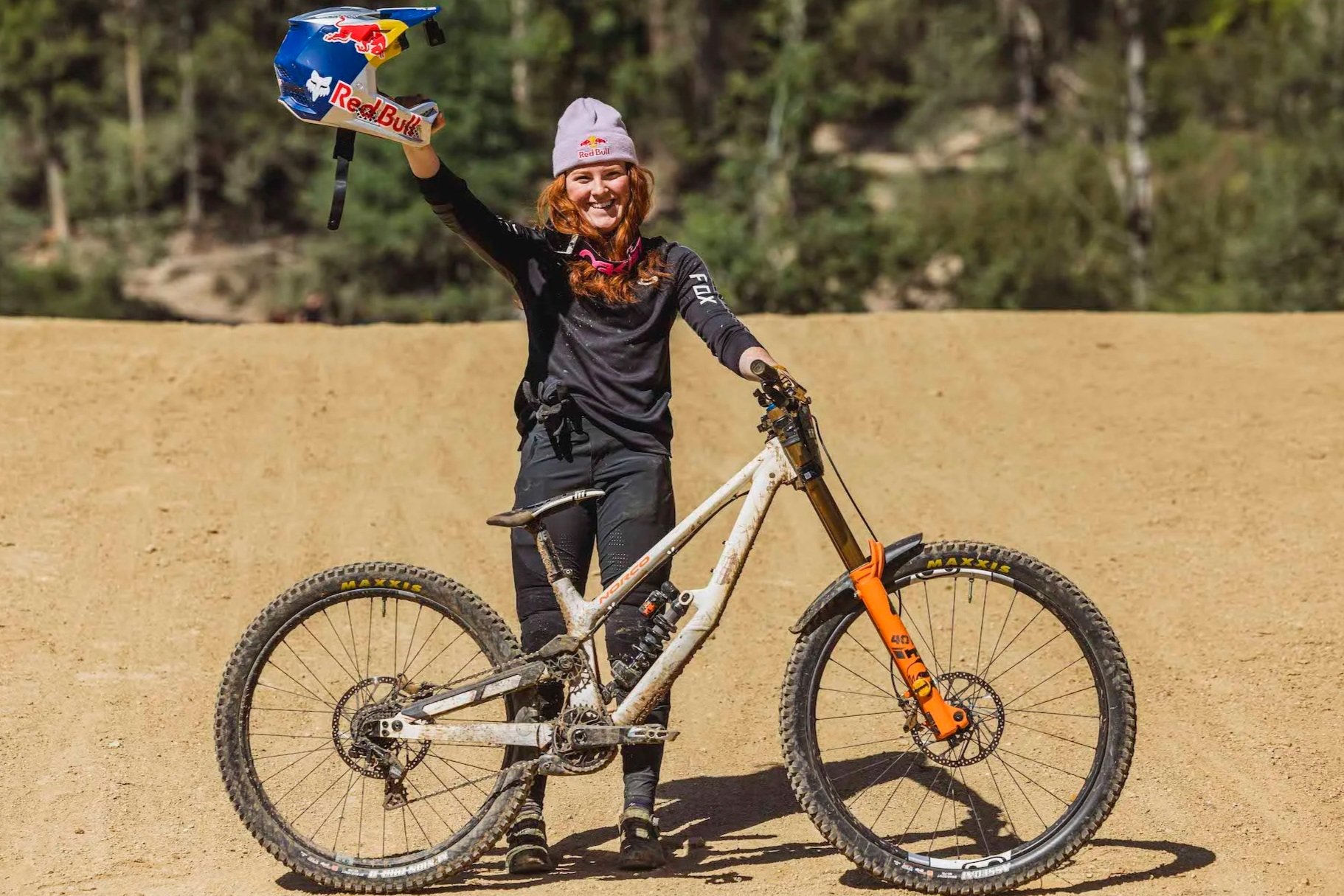
Gracey Hemstreet: Image taken from endurancesportswire.com
Gracey Hemstreet @ Red Bull Hardline
A lot of mountain bike history looks obvious after the fact.
Before the fact, it looks like this: a start ramp, a course that feels borderline unreasonable, and a bunch of people quietly thinking, “No one can do a full race run on this… not clean, not under pressure.”
Red Bull Hardline is basically built to create that feeling on purpose.
And then, in February 2024 at Maydena Bike Park in Tasmania, Gracey Hemstreet did the thing the sport had been circling for a decade. She dropped into finals and finished a full race run. Not a highlight clip. Not a “she almost had it.” A top-to-bottom race run, on the clock.
That moment is a MTB version of what people call the Bannister Effect: the weird, very human pattern where one person breaks a “limit,” then suddenly the limit starts looking less like physics and more like a story we were all agreeing to.
This isn’t a “how to ride Hardline” blog. Nobody needs that, and nobody should be taking Hardline-sized risks because of an internet article.
This is a science-backed rabbit hole (for entertainment), about why barriers break, why they break in bunches, and why Gracey’s run mattered even beyond Gracey.
The Bannister Effect
The original story comes from track running: Roger Bannister breaks the four-minute mile, and soon after, a bunch of other runners do too. The point is not that the human body magically evolved in three years. The point is that belief and expectation can be part of performance, especially when the barrier is right on the edge of what’s physically possible.
The Bannister Effect is basically a group update:
Before: “That’s not doable.”
After: “Oh. It is doable.”
Then: “So what does that mean for me?”
There are a few overlapping ideas here: social proof (we copy what looks possible), social identity (what “people like us” do), optimism bias (we lean toward hopeful explanations once a door opens), and performance psychology under pressure (other people watching can help or hurt).
That mix matters in MTB because riding is not just watts and skill. Riding is also risk, fear, reputation, and the running story in your head.
Why “impossible” can feel physical, even when it’s not
Here’s the part most people miss.
When riders say “I can’t,” they might be talking about strength or skill; but they might also be talking about uncertainty.
Uncertainty is expensive. It makes your brain conservative. Now add the social layer. In progression-heavy MTB, the fear is not only crashing. It’s also:
Crashing publicly.
Being the person who “shouldn’t have tried that.”
Becoming a cautionary tale.
So when someone breaks a barrier, they are not only proving the line is physically rideable. They’re proving something social and psychological too: you can attempt it, you can survive it, and you can belong here while doing it.
That “permission” effect is not soft. It changes what riders are willing to invest in.
Red Bull Hardline is basically designed to create a barrier
Hardline is not a normal race. It’s a pressure test. It compresses all the mental stuff into one week:
huge consequences for small mistakes
high speed commitment
unpredictable track grip
cameras, crowds, commentary
a culture that rewards “sending it,” but also remembers crashes forever
That combination creates the perfect conditions for a perceived ceiling. Not because the ceiling is fake, but because it’s hard to tell where physics ends and belief starts.
Which brings us to Gracey.
The moment: Gracey Hemstreet’s Hardline Tasmania run
At Red Bull Hardline Tasmania 2024, Gracey Hemstreet put down a full finals race run. She clocked 3:56.586 and became the first female winner at Hardline Tasmania, with Louise Ferguson also completing a finals run that day (despite crashes). (Pinkbike)
That’s the headline, but the deeper impact - A decade-long “maybe someday” became a timestamp.
And once that happens, the sport can’t unknow it.
What changed after Gracey, the real mechanics of the Bannister Effect
If you strip away the hype, the Bannister Effect is usually a stack of three changes:
1) The belief update
A barrier-break is proof, but it’s also a new mental model.
The research summary frames this as social proof and optimism bias: when one person demonstrates success, others update their expectations and start to believe the goal is attainable.
In MTB terms, it’s the difference between a line someone actually did, under pressure.
This changes training, how riders visualize, how coaches plan and what sponsors and teams take seriously.
2) The identity update
This is the quiet one.
Social identity theory, and closely related ideas like identity fusion, basically say we don’t just perform as individuals. We perform as members of groups, and we adopt the standards of those groups.
When Gracey finished Hardline, it didn’t suddenly make every woman think, “I can win Hardline.”What it did change was something more basic - It changed who felt like they belonged in the attempt.
3) The environment update (the unromantic one)
Barrier breaks don't happen in a vacuum. Beyond psychology, progress often rides on improved training methods, technical advancements, and safety infrastructure.
Red Bull's own approach to Hardline shifted in ways that matter here. The organization began actively inviting women to progression camps at Hardline - structured opportunities to ride the course, learn its features, and build familiarity before the pressure of race week. That's not inspiration. That's access, and access changes the math on who can realistically attempt a run, because nobody progresses on a course they've never touched.
That sits alongside other structural shifts:
course design decisions
protective gear norms
filming and media incentives
who has access to the right trails, mentors, bikes, and support
When one person breaks a barrier, it can trigger a resource shift. More attention, more invites, more backing, more structured progression. That is not separate from psychology, it is part of the same feedback loop.
The aftershock: other women showing up, and the field getting real
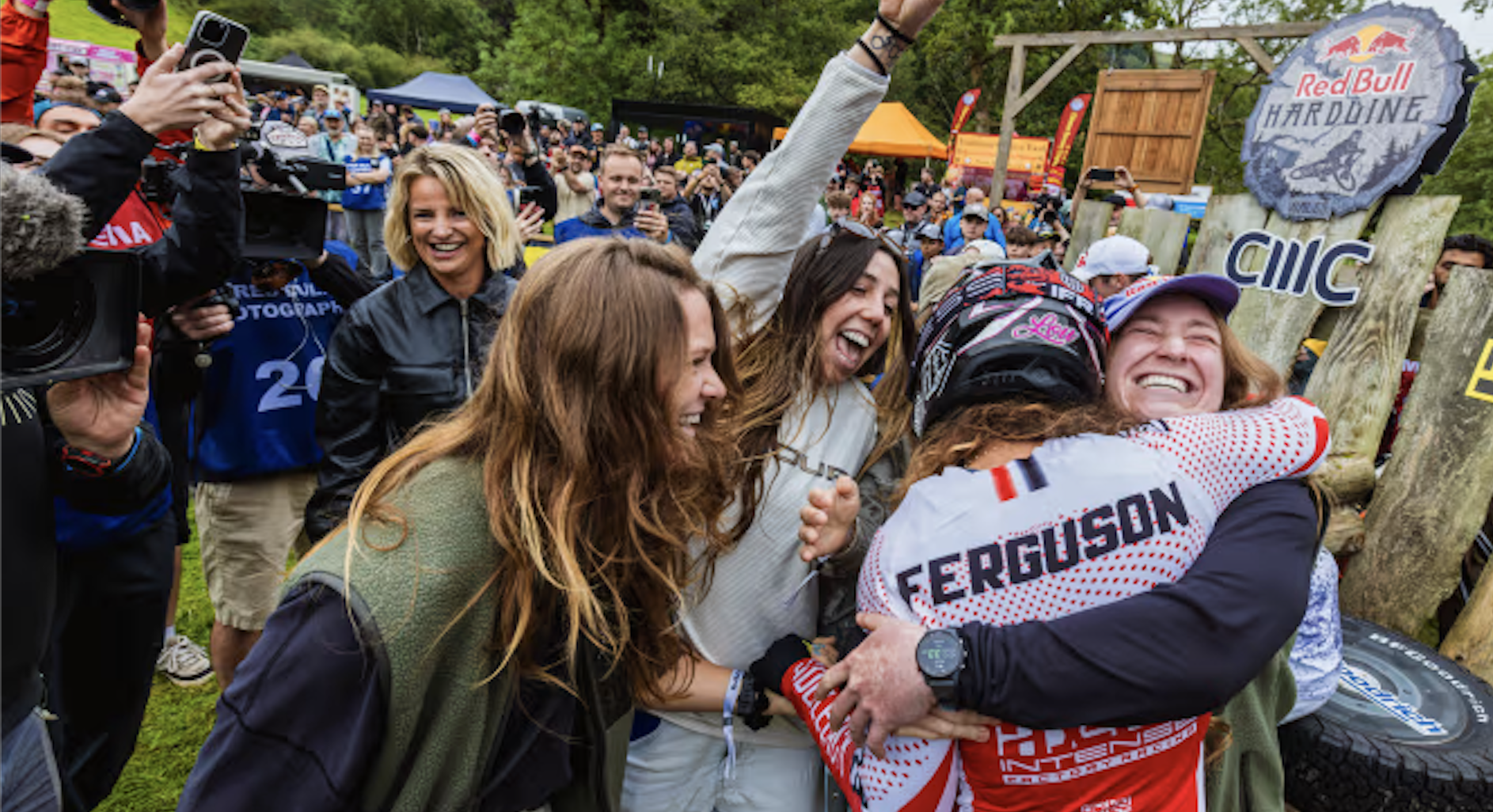
Hannah Bergemann, Cami Nogueria, and Vaea Verbeeck celebrating with Ferguson after her race run.
Photo: Dan Griffith/ Red Bull Content Pool
Below is a timeline on how the sport has changed shape
2014 through 2023
For nearly a decade, the record was a blank page. From 2014 through 2023, no woman had ever completed a full race run in Hardline finals.
2024 (Tasmania): women on the official list, and multiple riders pushing the course
Red Bull Hardline Tasmania put women on the official rider list for the first time. Louise-Anna Ferguson, Tahnee Seagrave, Hannah Bergemann, Cami Nogueira, plus wildcard spots for Gracey Hemstreet and Harriet Burbidge-Smith. (Pinkbike)
Red Bull’s own event recap also highlighted that multiple women rode large portions of the track across the week, even if not all qualified to race finals. (Red Bull)
This is evidence of a broader participation shift, not a one-off.
2025 (Tasmania): from “can a woman finish” to “there’s a women’s crown”
By 2025 in Tasmania, the conversation had already moved. Gracey took the women's class honours again, lining up in Sunday's finals alongside the men.
Pinkbike’s coverage also notes that Erice van Leuven qualified as the second woman in 2025, but missed finals after a practice crash. (Pinkbike)
This is what momentum looks like in real life, it’s messy, It includes progress and setbacks, and it still counts.
2025 (Wales): Louise Ferguson breaks the “original course” barrier
In 2025, Louise Ferguson became the first woman to complete a top-to-bottom run on the Hardline Wales course in qualifiers and race finals. (Red Bull)
This is a second Bannister moment inside the same story, because Wales is a different kind of problem. More natural tech, more “old Hardline,” more of the original mythology.
2026 (Tasmania): a deeper women’s roster
By 2026 in Tasmania, the women's field included Lou Ferguson, Mikayla Parton, Mille Johnset, Gracey Hemstreet, and Jess Blewitt. The sport went from “two riders in a women’s field” to a roster that looks like an actual competitive category, plus a repeat champion that sets a clear performance target for everyone else.
** Weather cancelled finals, seeding stood as the official result, with Gracey winning again.
The surprising twist: the Bannister Effect can add pressure, not just confidence
The romantic version of this story is: barrier breaks, everyone is inspired, the end.
The more realistic version is: barrier breaks, and now a new standard exists.
That can help performance, but it can also create new pressure.
Enter another idea - the presence of others effect, social facilitation, and the risk of choking under heightened scrutiny. It’s not always a boost.
In MTB terms:
When nobody has ever done it, failure is expected.
Once someone has done it, failure feels like underperformance.
That shift can change how athletes ride. Sometimes for the better, sometimes for the worse. It’s one reason the second wave is not guaranteed to be smooth.
The Bannister Effect is not magic. It’s a real psychological lever, inside a system of resources, opportunity, and risk.
It’s not only belief, it’s selection and support
Red Bull Hardline didn’t suddenly become easier in 2024. Women didn’t suddenly become more capable in 2024. What changed was that the sport allowed a clearer pathway for that capability to show the participation pool grows. Once the participation pool grows, the probability of a finisher grows. That is basic math, not only mindset.
This does not reduce Gracey’s achievement; it actually makes it more important. Barrier-breaks often require the athlete to carry extra weight:
more scrutiny
fewer predecessors
more reputational risk
fewer “safe” reference points
That’s why these moments ripple.
The new map
If you’re a rider, the takeaway is not “go send bigger stuff.”
It’s this: your brain treats “possible” like a category, not a measurement. And categories can change fast, when the right person proves a new version of reality.
If you’re a coach, the takeaway is even simpler: progression is not only physical. It’s social. It’s identity. It's expectation. It’s permission.
TL;DR
Gracey Hemstreet's Hardline finish didn't flip a single switch - it aligned belief, expectation, and opportunity in a sport where all three had been slightly out of sync. The Bannister Effect isn't a moment; it's a system recalibrating. Progression stalls when environments quietly signal what's "normal" and what's "for people like you." When those signals shift - not recklessly, but collectively - reference points change.
And in mountain biking, as in coaching, reference points shape everything.
On March 5th we'll be hosting a Masterclass webinar - Coaching Women’s MTB Programs
GSMBC Evolve Members get access to all Masterclass Webinars.
(Evolve members get access to all Masterclasses)
If you want to go deeper into the science behind this blog, you can check out the references below:
Bandura, A. (1977). Self-efficacy: Toward a unifying theory of behavioral change. Psychological Review, 84(2), 191–215. https://doi.org/10.1037/0033-295X.84.2.191
Evans, J. St. B. T., & Stanovich, K. E. (2013). Dual-process theories of higher cognition: Advancing the debate. Perspectives on Psychological Science, 8(3), 223–241. https://doi.org/10.1177/1745691612460685
Steele, C. M., & Aronson, J. (1995). Stereotype threat and the intellectual test performance of African Americans. Journal of Personality and Social Psychology, 69(5), 797–811. https://doi.org/10.1037/0022-3514.69.5.797
Swann, W. B., Jr., Jetten, J., Gómez, A., Whitehouse, H., & Bastian, B. (2012). When group membership gets personal: A theory of identity fusion. Psychological Review, 119(3), 441–456. https://doi.org/10.1037/a0028589
Tajfel, H., & Turner, J. C. (1979). An integrative theory of intergroup conflict. In W. G. Austin & S. Worchel (Eds.), The social psychology of intergroup relations (pp. 33–47). Brooks/Cole.
Zajonc, R. B. (1965). Social facilitation. Science, 149(3681), 269–274. https://doi.org/10.1126/science.149.3681.269
