Point of Commitment: Why Hesitation Causes the Crash You're Trying to Avoid
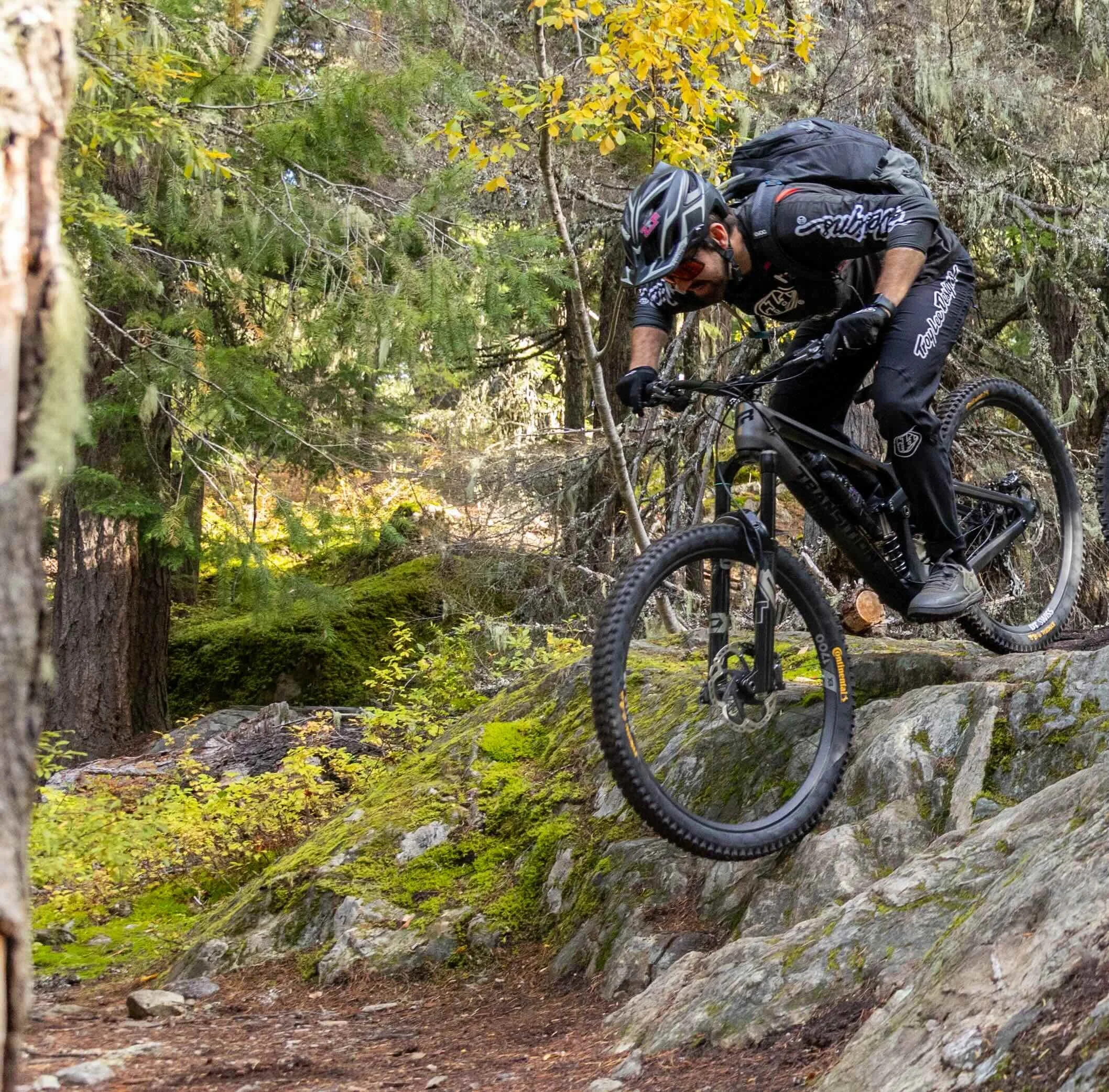
Every steep feature has a moment in it that the rest of the trail doesn't have. You roll toward the lip of a chute or the edge of a drop, and somewhere in the last bike length there's a point where the planning has to stop and the body has to take over. It's the boundary where thinking ends and doing begins, the point of commitment.
When you’re approaching a feature, choosing your Point of Commitment is a great tool to reduce the chances of failure. Commit, and the skills you've built run themselves. Hesitate, and you don't just stall at the top. You set off a chain of events in your eyes, your nervous system, and your body position that tends to produce the exact crash you were trying to avoid.
Hesitation feels like the safe option, a pause to gather yourself before something that scares you. But hesitation isn't neutral, it actively changes how you see the trail and how your body sits on the bike, and almost none of those changes help you.
Understanding why is one of the more useful things a rider or a coach can carry up the hill.
What SCIENCE SAYS Hesitation Actually Does to You
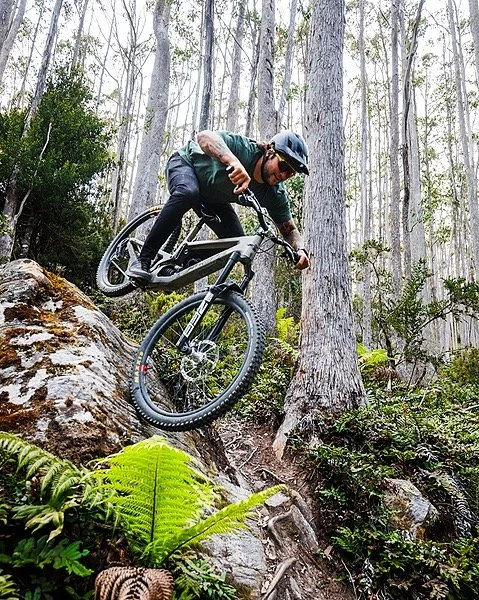
Start with the brain…
…because that's where the trouble begins. Your brain is wired for survival, not for clean riding, and the two don't always want the same thing. When you encounter something it reads as a serious threat, the amygdala (the part that handles fear and danger) registers it as a survival-level problem and reacts in milliseconds.
It doesn't distinguish between a genuine hazard and a steep drop you've ridden before, and it treats the social version of the threat, the fear of looking bad in front of your mates, as roughly the same kind of emergency. It then floods the body with adrenaline - which is useful if you need to sprint away from danger. It's the wrong setup entirely for the fine control and clear vision a committed feature asks for.
The first place it shows up is in your eyes. When you're calm, good riders scan the trail efficiently, the gaze moving between what's directly in front and what's coming next, landing on the few features that actually matter (We coach this as Terrain Awareness, the constant trade between "now" and "next."). Worse, the thing you're afraid of becomes a magnet.
This is target fixation, and it's well documented across sports: a soccer player taking a penalty stares at the goalkeeper and tends to put the ball straight at him; a rider stares at the rock they want to miss and drifts toward it. Because the bike follows your eyes, fixing your gaze on the hazard is, in a real mechanical sense, aiming for it.
Finally, what hesitation does is the most counterintuitive. The skills you've drilled for years are stored as automatic programs. You don't think your way down a roll-down you've done a hundred times, you just do it, and that's exactly why it works: the automatic version runs fast, with all the muscle timing handled in the background. Hesitation flips the switch from automatic to manual. You start consciously managing movements that are supposed to run themselves.
Researchers call this reinvestment, or paralysis by analysis, and Richard Masters' work showed how reliably it breaks a skilled movement under pressure. The conscious mind is slower and runs one step at a time, so a smooth, parallel sequence gets chopped into jerky, separate pieces. Muscles that should fire in turn end up tensing together and locking the joints. You've taken a skill you owned and made yourself a beginner at it, at the worst possible moment to be one.
How to Ride Through the Point of Commitment
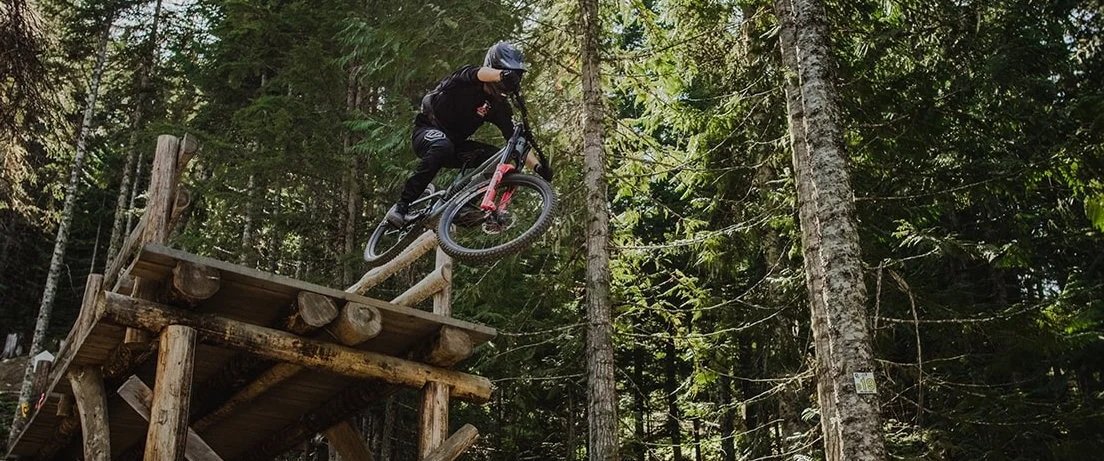
The point of commitment strategy helps to work against the instincts of hesitation, and is the place where planning has to hand the bike over to good riding.
By the time you reach it, you've already done the work. You understand what good riding looks like on the feature in front of you, and you've simplified it down to one or two cues. Your braking is done, you're on your line, and the only thing left is whether you're going to do it. Once you've decided, you commit and let the automatic processes you've worked on take over.
This is why choosing your point of commitment matters as much as any single technique. Past that spot, you're not weighing the feature any more, you're riding it, and the cue is simply what keeps your conscious mind from grabbing the controls back while the rest runs on its own.
**For some riders the hesitation isn't just “in their head”, and can be a loop that’s triggered from previous trauma. After a crash, the nervous system can keep running a protective program long after the body has healed, dialling down the muscles around an old injury and leaving a rider tentative without knowing why. That isn't weakness, and it won't yield to willpower; It responds to the same tools, applied more patiently: smaller steps, more safe reps, and time spent rehearsing the movement in your head first.
The Key Takeaway
Hesitation isn't a character flaw, and it isn't beaten with courage. It's a protective reflex doing exactly what it evolved to do, in a setting where its instincts happen to be wrong. You don't get past it by feeling braver or by pretending the feature isn't scary. You get past it by managing the fear down far enough, and committing the decisions early enough, that your body can do the thing it already knows how to do.
The point of commitment rewards decisions made early. By the time you're at the lip it's too late to think, and the feature belongs to whatever your eyes and body do on their own. So the real work is front-loaded: commit the eyes, set a position you can move in, sort the braking on the approach, and choose the one cue, all before the moment arrives, so that when it does the skills you've built are free to run.
Coach's Note
For coaches, the most useful reframe here is that hesitation is a vision and emotion problem before it's a technique problem. When a rider stalls at the top of a feature, the instinct is to start fixing their body position. Usually the cause sits upstream of that: their eyes are locked on the hazard, or their nervous system has them stiff before they've even moved.
That's why we treat the mental side as its own pillar rather than an afterthought. Confidence and emotional control get built the same way physical skills do, with steps small enough that the rider keeps succeeding, single cues that hold their focus on one thing, and language that frames fear as information to manage rather than an enemy to defeat.
Get a rider committing their eyes early and trusting a position they can actually move in, and a you’ll be setting them up for success.
Sign up for a free GSMBC Membership and get access to our reference guide, webinars, and the coaching frameworks we build our courses on.
Join for free at https://gsmbc.pro/member-benefits, or see the full course schedule at https://gsmbc.pro.
Sources
Joan Vickers' quiet eye research on expert versus novice gaze (overview). Richard Masters and Jonathan Maxwell on reinvestment and the breakdown of skilled movement under pressure (The Theory of Reinvestment). Target fixation as a documented attentional phenomenon in steering and obstacle avoidance.