Does Reaction Time Training Actual Work?
You’ve probably seen this before
An F1 driver stands with their arms outstretched. Someone else holds a tennis ball just below their open palm. The ball drops. The driver tries to catch it before it hits the ground.
You see versions of this in almost every sport. Blinking lights on a board. Beeping apps. Random cues. Athletes trying to shave milliseconds off their response time, as if faster fingers translate directly to faster performance on the field, court, or trail.
It is compelling content. And the question behind it is genuinely interesting: does reaction time training actually work? And more specifically for us, does it matter for mountain biking?
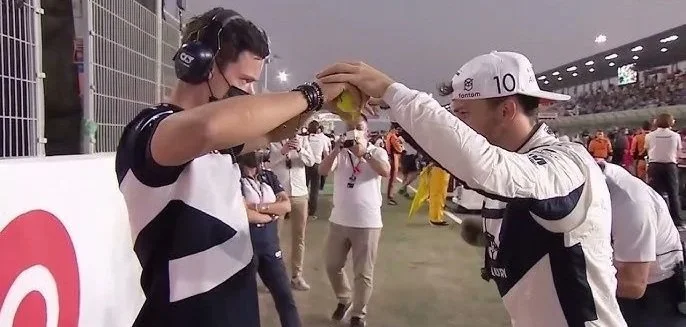
F1 Driver Pierre Gasly does the tennis ball drop drill.
Try it yourself first
Before we get into the science, here is a quick benchmark exercise to try. Open this link on your computer or phone:
https://humanbenchmark.com/tests/reactiontime
A red box will turn green. Click as fast as you can. It will give you a score in milliseconds and compare you to a large dataset of other users.
Keep that number in mind. We will come back to what it means, and more importantly, what it does not mean.
What is reaction time, actually?
Most people treat reaction time as a single number. In reality, it is a chain of events. When something happens that demands a response, your nervous system has to work through several stages before your body moves:
First, you detect and identify the stimulus. Your senses pick something up.
Then you decide what to do about it. Even a simple decision has a cost.
Finally, your motor system sends the signal to your muscles, which have to produce actual force and movement.
The science of limits: how fast can a human actually react?
Here is where it gets genuinely interesting; reaction time is not the same depending on which sense you are using.
Auditory vs. visual vs. tactile
For a simple reaction task (one cue, one response, no decision-making required), compiled research puts typical mean values roughly like this:
Sound: around 140 to 160 ms
Light: around 180 to 200 ms
Touch: around 155 ms, often described as intermediate
Why is sound faster? Auditory signals can reach the brain in roughly 8 to 10 milliseconds. Visual signals take approximately 20 to 40 milliseconds to reach the brain. That upstream difference flows through to the final response time.
This is part of why start guns, buzzers, and beeps are used in sports rather than flashing lights.
Practically, what is the human limit?
The fastest believable voluntary reaction to a simple cue in a prepared athlete is probably somewhere in the neighbourhood of 80 to 120 ms, depending on what is being measured (EMG onset vs. force threshold vs. visible movement), the athlete, and the detection system.
For most people, especially for simple visual tasks, realistic best-day performance is usually far above that. Typical simple visual reaction times are often described in the 180 to 200 ms range
Reflexes: the body's fast lanes
Reflexes are a different category from conscious reaction entirely. Some human responses happen in tens of milliseconds because they are reflex loops, not deliberate decisions. Short-latency stretch reflexes can fire in as little as 20 to 50 milliseconds, and the acoustic startle response can trigger a blink in roughly 30 to 40 milliseconds.
This is why riding sometimes feels automatic. When your body saves you on a trail, your conscious mind is usually not involved. Your nervous system took a faster, more direct route.
But here is the key coaching insight that makes this directly relevant to how we teach riders
These automatic responses work best when you are pre-loaded and positioned correctly. A strong, stable stance on the bike is about giving your nervous system the mechanical readiness to use those faster pathways before conscious thought even enters the picture.
SO, Can you actually train reaction time?
Yes, but with important limits, and with a catch that most reaction time content skips over entirely.
What changes with practice
Practice effects on reaction time are real. Research shows that three weeks of practice can meaningfully reduce response time to a visual stimulus, and that these improvements can persist for weeks. Responses also become more consistent with regular practice, and knowing a cue is coming soon (a warning period) speeds response significantly.
But the ceiling is real too. Peripheral transmission speeds and the time it takes muscles to build force DO NOT change dramatically with training. What improves more is:
How efficiently you detect the stimulus
How prepared your motor plan already is before the cue arrives
How little actual deciding you have to do in the moment
Elite performance = Seeing, Strategy, and [Movement Execution]
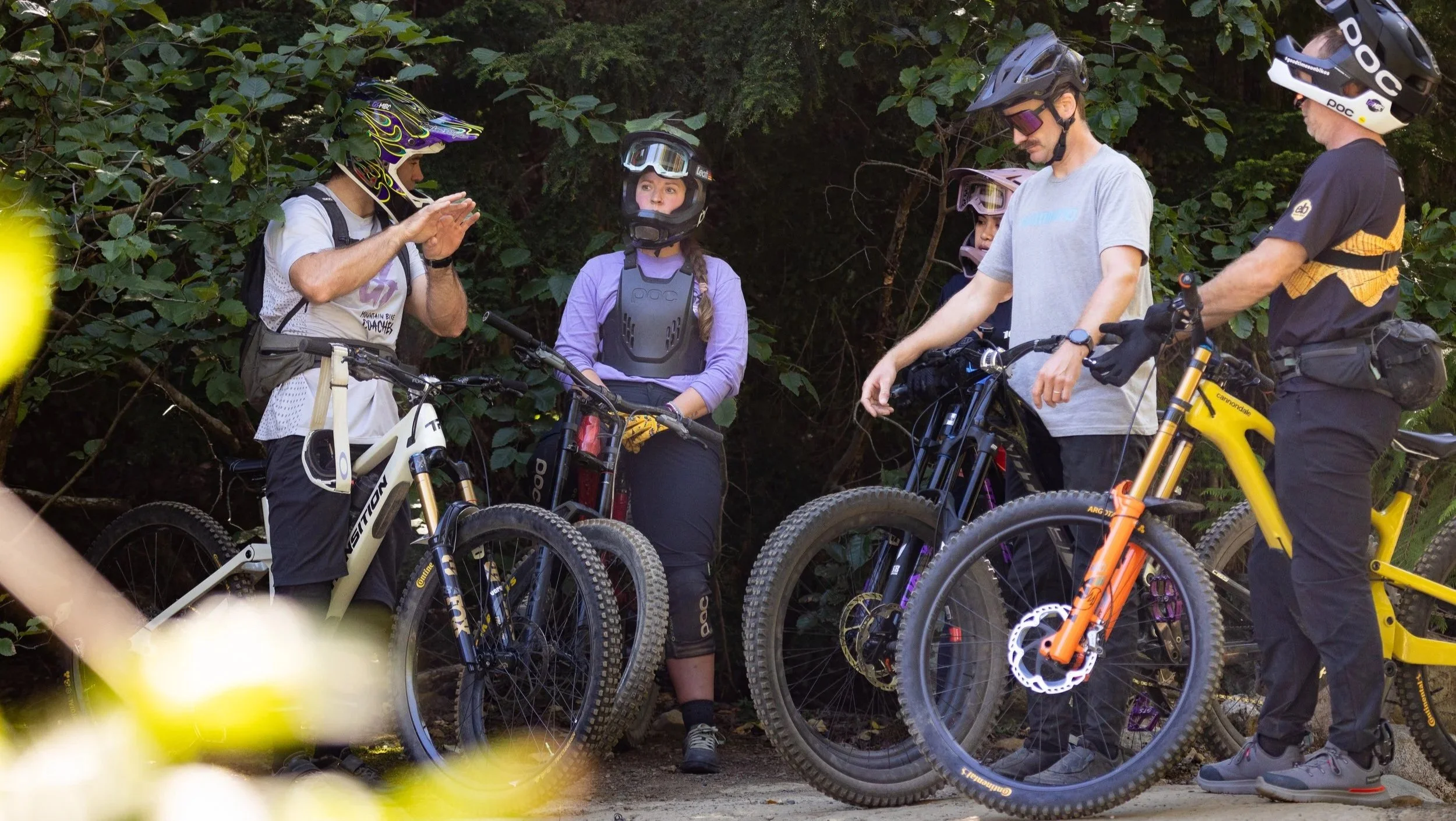
This pattern appears across sports. Elite performance is usually explained by better perception (seeing the right things, earlier), better strategy (being in the right place, with the right speed, before the moment of demand), and better movement execution (running a more efficient motor pattern when it counts).
For mountain biking specifically, this matters a lot. The rider who responds fastest to a root they only saw at the last second is not the one winning. The rider winning is the one who read the terrain 10 metres earlier, adjusted speed before the feature, and put their body in a position that gave their nervous system something to work with.
This is exactly where biomechanics comes in.
Understanding how movement patterns work, what stability actually means in dynamic terrain, and how to teach balance that responds rather than just holds, is where coaching gets powerful.
How this maps to mountain bike coaching
GSMBC's Six Pillars of Coaching give us a clean framework for where reaction time fits, and where it does not.
Riding: build skills that reduce decision time
At speed, noticing an obstacle and reacting is often already too late. The skill is building predictive habits: look ahead, read terrain early, and manage speed before the moment of demand.
Coaching: train perception-to-action, not just button pressing
The Human Benchmark test is fine for what it is: a measure of simple visual reaction time, not trail riding skill. The real coaching work is building drills that train the coupling between seeing a trail cue and executing the right movement, consistently, on real terrain.
Mental: readiness, attention, and not overthinking
Reaction time is strongly affected by readiness and attention. Calm focus, clear pre-ride routines, and deliberate trail scanning are not just mental skills. They are performance tools that reduce effective response time before the demanding moment even arrives.
Guiding: safety comes from margin, not milliseconds
The guiding perspective is the most important one in practical coaching: teach riders to create time. Better line choices, earlier speed management, and appropriate spacing from hazards reduce the probability that anyone ever needs a last-ditch reaction save.
Quick tip: equipment as your reaction time buffer
This one often gets overlooked. If voluntary reaction time plus neuromuscular delay sits in the 100 to 200 ms range even in optimal conditions, then equipment that increases stability and reduces surprise gives you meaningful margin.
Small setup changes, such as brake lever reach, tyre pressure, and suspension balance, can reduce how often you get knocked offline and forced into a late correction.
What actually Works?
Reaction time training can work, but the ceiling is low and the gains are modest.
What moves the needle more reliably is everything around it: better perception, smarter positioning, and more efficient movement patterns. That is where the real improvement lives, and it is also where most riders have the most untapped room to grow.
[FREE] Applied Biomechanics for MTB Coaching, GSMBC Webinar, March 12
If this article made you curious about the connection between movement science and trail performance, GSMBC's upcoming FREE biomechanics webinar is worth your time. You will come away with a clearer understanding of movement patterns for cornering, pedalling, drops, and steep terrain, and how to teach stability and balance in a way that is actually dynamic, not just a fixed body position.
Register at gsmbc.pro/webinars
If you want to learn more about reaction time, here are the references we used for this article:
Luce, R. (1986). Response Times: Their Role in Inferring Elementary Mental Organization.
Kosinski, R. (2013). A Literature Review on Reaction Time.
Pain, M. & Hibbs, A. (2007). Sprint starts and the minimum auditory reaction time.
Shelton, J. & Kumar, G. (2010). Comparison between auditory and visual simple reaction times.
Schmidt, R. & Lee, T. (Motor Control and Learning).
Welford, A. (Choice Reaction Time: Basic Concepts).
Human Benchmark Reaction Time Test
World Athletics Competition Rules (False Start Reaction Time Threshold)
GSMBC Reference Guide and Advanced Coach Flow Course Materials.